Store-brand vitamins alone generated $2,296,877,652 in US sales during 2025, capturing 20.8% of the vitamin category's dollar share, according to PLMA's 2025 store brand report. That kind of volume proves the model works, but success still hinges on picking the right supplier.
Many brand owners struggle with comparing manufacturing models, verifying quality systems, and understanding minimum order quantities before they sign anything. This guide covers how private label works, how it differs from white label and contract manufacturing, and how to vet a US supplier before committing.
Key Takeaways
- Private-label manufacturing skips factory investment, but supplier quality systems shape your brand's reputation
- Customization, formula ownership, and speed separate private label, white label, contract manufacturing, and contract packaging
- Vet suppliers through documented capabilities, samples, certifications, and written agreements
- Health products require category-specific FDA review—"FDA registered" never means "FDA approved"
What Is Private Label Manufacturing?
Private-label manufacturing is when a manufacturer makes a product that another business sells under its own brand. The manufacturer usually handles production, quality control, and sometimes packaging. The brand owner owns marketing, sales, and the compliance decisions behind labeling and claims.
The Typical Workflow
Most private-label projects follow a similar path:
- Select a product or base formulation that fits your target category
- Define specs for packaging, dosage form, and label content
- Review samples before committing to a production run
- Approve labeling for compliance and branding
- Place the order and complete quality checks
- Arrange fulfillment to your warehouse or distribution partner

Why Brands Choose This Model
Private label gives smaller brands access to production capabilities they couldn't otherwise afford:
- Skip the cost of in-house equipment and manufacturing staff
- Launch faster than building a production line from scratch
- Free up time for positioning, sales, and customer relationships
- Tap established quality systems already running at the supplier
Where It Falls Short
Those advantages come with real trade-offs:
- Less formulation exclusivity than fully custom development
- Minimum order quantities that can stretch smaller brands
- Dependence on the supplier's capacity and timeline
Outsourcing does not remove the brand owner's job. You still verify compliance and confirm the product fits your market.
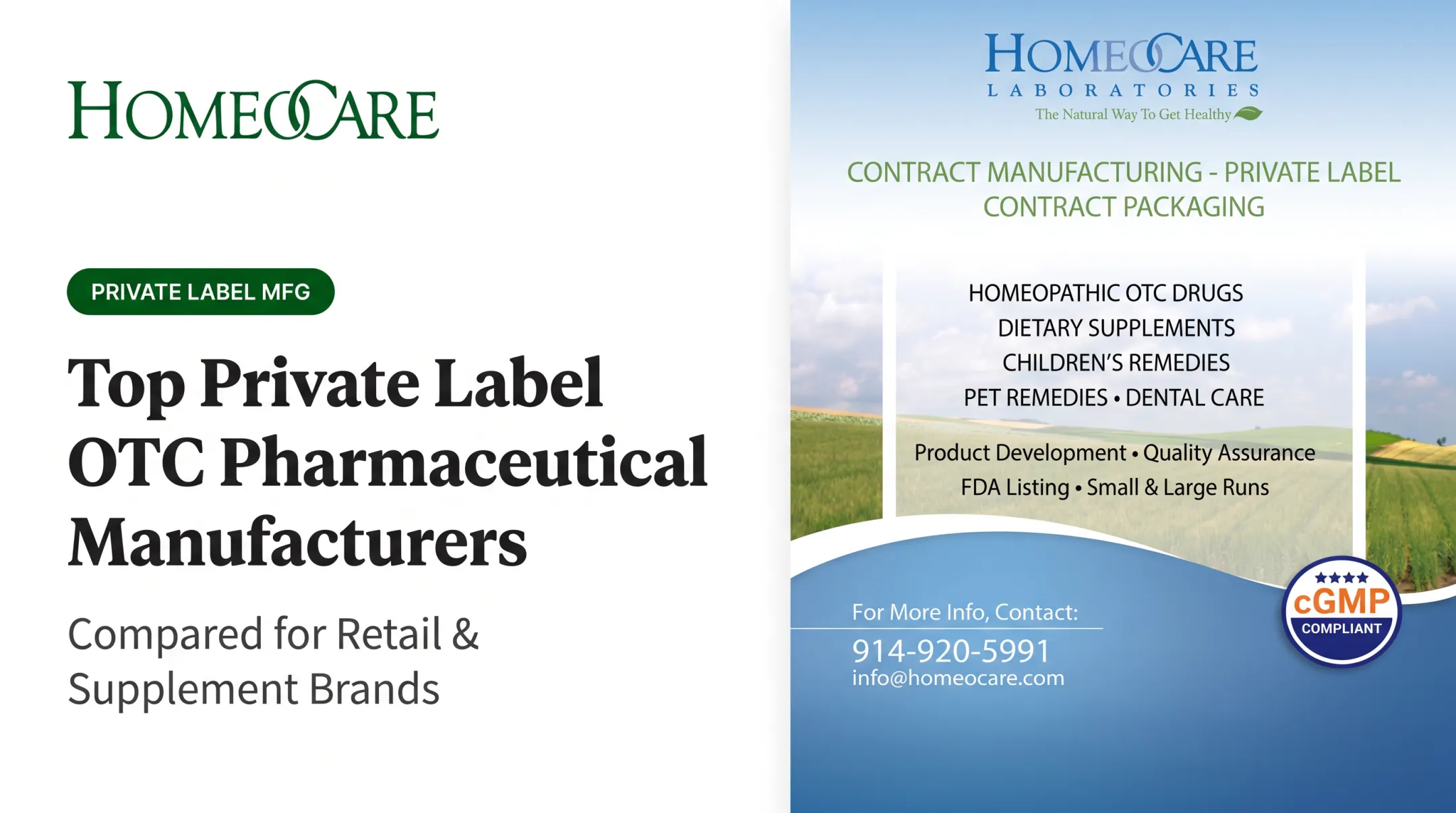
Some suppliers bundle private-label production with contract manufacturing and packaging in one place. Homeocare, for example, has operated as a cGMP-compliant, FDA-registered homeopathic OTC drug establishment since 1995, with capabilities across homeopathic remedies, herbal products, and nutritional supplements in tablets, capsules, pellets, creams, and liquids.
Private Label vs. White Label vs. Contract Manufacturing
Terminology in this space varies by industry, and that causes real confusion for first-time buyers. Here's how the terms typically break down for US supplement and wellness brands.
Private label generally means a product manufactured specifically for your brand, using an existing formula the manufacturer already produces.
White label commonly refers to a single existing product that multiple businesses rebrand with minimal changes.
Contract manufacturing is broader: you may supply a proprietary formula, raw materials, or technical specifications, while the manufacturer provides equipment and production expertise.
| Factor | Private Label | White Label | Contract Manufacturing |
|---|---|---|---|
| Customization | Moderate | Minimal | High |
| Formula ownership | Usually the manufacturer's | Usually the manufacturer's | Often the brand's |
| Speed to market | Fast | Fastest | Slower |
| Setup investment | Low to moderate | Low | Higher |
| Exclusivity | Limited | Rare | Possible |
Where Contract Packaging Fits
Contract packaging (sometimes called toll manufacturing) applies when a brand already has a finished product or formulation but needs filling, labeling, or packing capacity. This differs from the models above because no formulation work happens at all — it's purely a production-capacity arrangement.
Choosing the Right Model
Use this quick filter to narrow the decision:
- Private label for a faster launch using an available product
- White label when minimal customization is acceptable
- Contract manufacturing when you need control over a proprietary formula or specialized product
How to Find and Vet Private Label Manufacturers and Suppliers
Start with a written supplier brief before contacting anyone. Include:
- Product category and dosage form
- Target customer and packaging preferences
- Estimated order volume and sales channels
- Launch timeline and US compliance requirements
This document saves time and gets you comparable quotes later.
Building a Shortlist
Find candidates through manufacturer directories, trade associations, industry events, referrals, and direct outreach. Confirm that each candidate actually manufactures the product. Some companies that appear in searches are brokers who outsource production elsewhere without telling you.
What to Request Before Talking Volume
Ask every serious candidate for an initial capability package covering:
- Facility details and product categories produced
- Available formats and minimum order quantities
- Production capacity and current lead times
- Packaging, labeling, and testing options
- Certifications and examples of comparable work
Evaluate Documentation, Not Just Samples
Product samples matter, but documentation matters more. Check for consistent product quality, ingredient specifications, certificate-of-analysis availability, and how responsive the supplier is to your questions.
Specifications are not a formality. In a 2024 warning letter, the FDA flagged US supplement manufacturer Formulation Technology, Inc. for missing component specifications and finished-batch strength specifications. That's exactly the kind of gap a buyer should catch before placing a large order, not after.
Comparing Quotes and Locking in Terms
Compare quotes on a like-for-like basis:
- Formulation or setup fees
- Packaging, testing, freight, and storage
- Payment terms and reorder requirements
Once you've picked a supplier, put everything in writing:
- Specifications and change control
- Quality standards and handling of nonconforming goods
- Confidentiality and intellectual-property ownership
- Recall or termination procedures

Homeocare is one example worth investigating for brands in the homeopathic remedy, herbal, or nutritional supplement space, given its FDA-registered establishment status and cGMP compliance. That said, no supplier's credentials substitute for your own vetting process.
Key Considerations for US Health and Wellness Products
Regulatory requirements depend entirely on product category. A homeopathic remedy, a dietary supplement, a cosmetic, and a food product each fall under different FDA rules. Research the applicable category before finalizing product claims.
Registration Is Not Approval
This distinction trips up more brand owners than almost anything else. FDA explicitly treats homeopathic products as drugs, and it states that none of the products labeled homeopathic are FDA-approved. A December 2022 policy directs risk-based enforcement toward higher-risk unapproved homeopathic products.
"FDA registered" and "cGMP compliant" describe real operational facts about a facility. They do not mean the FDA has approved or endorsed a specific product. Only use supplier credentials the manufacturer can substantiate with documentation.
Label and Claims Review
Before launch, check your label for:
- Accurate ingredient names and required directions
- Warnings and allergen disclosures where applicable
- Net quantity and manufacturer information
- No unsupported disease-treatment or safety claims
Questions to Ask Every Supplier
Ask prospective manufacturers directly about:
- Incoming-material controls and batch records
- Identity and purity testing procedures
- Finished-product testing and quality-control release
- Complaint handling and recall procedures
Outsourcing production doesn't outsource responsibility. The brand owner still makes the final call on marketing, labeling, and marketplace compliance, even when a third party handles manufacturing.
Private-Label Product Categories and Supplier Fit
Private-label manufacturing spans dietary supplements, homeopathic remedies, skincare, food and beverage, household goods, pet products, and apparel. Each category demands different equipment, testing protocols, and regulatory expertise, so a supplier's strength in one area doesn't guarantee competence in another.
Format Drives Supplier Selection
Product format determines the capabilities a supplier must have:
- Tablets, capsules, and pellets require compression and filling equipment
- Powders need blending and bulk development capabilities
- Liquids, sprays, and oils require different filling lines
- Creams, ointments, and gels need specialized mixing and stability support
Matching Supplier Capacity to Your Scale
Review minimum order quantities, whether pilot runs are available, and how the supplier handles replenishment as your volume grows. A supplier that only supports large runs won't work for a brand testing a new SKU, and one built for small batches may not scale with you later.
Homeocare manufactures homeopathic products, herbal formulations, nutritional supplements, and essential oils across multiple formats, and supports both small and large production runs. Confirm current capacity and project-specific requirements directly before you commit.
Is Private-Label Manufacturing Profitable?
Profitability depends on unit economics, not the private-label model itself. A product can carry healthy margins or lose money regardless of how it's manufactured — the math comes down to what you charge versus what it actually costs to get a unit into a customer's hands.
Costs That Affect Your Margin
Factor in all of these before setting a price:
- Landed product cost and packaging
- Testing and compliance work
- Freight, warehousing, and fulfillment
- Platform fees, marketing, and returns
- Inventory carrying costs
A Simple Break-Even Framework
Calculate break-even using your selling price, variable costs per unit, fixed launch costs, and expected order volume. Research current benchmarks for your category instead of general industry averages—margins differ widely across supplement formats, homeopathic remedies, and other wellness products.

Risks That Erode Profitability
Watch for these common pitfalls:
- High minimum order quantities that tie up cash in slow-moving inventory
- Packaging changes that trigger rework
- Quality failures that require re-labeling or recalls
- Rushed freight costs from poor lead-time planning
- Dependence on a single supplier with no backup plan
Protect margins by validating demand before you scale:
- Start with a focused product line and realistic forecasts
- Use samples and a small pilot run when your supplier allows it
- Document a reorder plan before adding more SKUs
Working with an experienced private-label manufacturer—especially one with strong quality control and flexible production options—helps you avoid the cost spikes that wipe out early profits.
Frequently Asked Questions
What is private label manufacturing?
Private label manufacturing is an arrangement where a third-party manufacturer produces goods sold under your brand name. The manufacturer typically handles production and quality control, while the brand owner manages sales and marketing.
How do I find a private label manufacturer?
Search supplier directories, trade associations, and industry events, and ask for referrals from other brand owners. Confirm each candidate actually manufactures your product category, then request samples, certifications, and written quotes before committing.
Who are some private label manufacturers in the US?
Suitable suppliers depend heavily on your product category and format. For homeopathic remedies, herbal products, or nutritional supplements, Homeocare is one FDA-registered option worth researching directly for current capabilities and requirements.
Is private label manufacturing profitable?
Profitability depends on your pricing, landed costs, order volume, demand, and inventory management rather than the manufacturing model itself. Two brands using the same supplier can see very different margins based on these factors.
What are the most profitable private label products?
Profitability varies by market demand, differentiation, compliance requirements, production costs, and repeat-purchase potential. There's no universal ranking. Research your specific category's benchmarks before assuming a product will perform well.
Is private labeling legal?
Yes, private labeling is legal in the US. Products must still comply with applicable labeling, safety, advertising, intellectual-property, and category-specific regulatory requirements, which vary by product type.