Introduction
Acne doesn't stop being frustrating just because you've outgrown your teenage years. Many adults still deal with breakouts that affect their confidence at work, on dates, or just in the mirror each morning. That frustration sends a lot of people searching for natural and homeopathic acne treatment options.
This article covers the homeopathic remedies most often discussed for acne. You'll learn what research and product labels can realistically tell you, when a dermatologist should get involved, and why "natural" isn't automatically risk-free.
Homeopathy isn't a guaranteed cure. If you're dealing with painful, cystic, or scarring acne, proven medical treatment should be part of your plan.
Key Takeaways
- Choose remedies by your full symptom picture, not a generic acne formula.
- Follow label directions—don’t copy dosing tips from random online articles.
- Get professional evaluation for cystic, sudden, or hormone-related breakouts.
- Treat FDA registration and cGMP compliance as manufacturing standards, not proof a product works.
What Does Homeopathy Mean for Acne?
Homeopathy is a system of medicine built on two core ideas: "like cures like" and the "law of minimum dose." A substance that might cause symptoms in a healthy person is used, highly diluted, to treat similar symptoms. Some homeopathic preparations are diluted so extensively that no molecules of the original substance remain.
The tradition traces back to German physician Samuel Hahnemann in the early 1800s. Practitioners don't typically treat "acne" as a single condition. Instead, they consider:
- Where the breakouts appear (jawline, chest, back)
- What the lesions look like (itchy, pustular, cystic)
- Timing patterns, including menstrual cycles
- Stress levels and general health
Individualized Tradition vs. Clinical Proof
This individualized approach is central to homeopathic philosophy, but it creates a problem for proving effectiveness. Demonstrating that a treatment works for acne requires well-designed, independently reviewed clinical trials, not just a consistent internal logic.
The National Center for Complementary and Integrative Health (NCCIH) reports little reliable evidence that homeopathy effectively treats any specific condition. That assessment includes a 2015 comprehensive review that found no dependable evidence of effectiveness across the board.
That doesn't mean acne-specific research doesn't exist. It does, and we'll get into it. But existing studies don't overturn this cautious baseline.
Treat claims of "deep," "permanent," or guaranteed acne cures with skepticism unless strong evidence backs them. Anecdotal improvement isn't proof of causation.
Don't stop a prescribed acne treatment or delay a medical evaluation just because you're trying a homeopathic product alongside it.
Homeopathic Remedies Commonly Discussed for Acne
This section is an overview of remedies discussed in homeopathic literature and products. It's not a personalized prescription, and it's not confirmation that any single ingredient treats acne.
A 2022 double-blind, randomized, placebo-controlled trial assigned 126 people with acne to either individualized homeopathic medicines or placebo. Sulphur was prescribed in 17.5% of cases and Pulsatilla nigricans in 10.3%.
After three months, the homeopathy group showed numerically better results, but the difference wasn't statistically significant compared to placebo. That trial tested an individualized approach as a whole, not these ingredients as standalone treatments.

Here's how commonly discussed remedies stack up against the available evidence:
| Remedy | Traditional Indication | What the Evidence Shows |
|---|---|---|
| Sulphur | Itchy, irritated eruptions | Included in the 2022 RCT; no independent efficacy established |
| Hepar sulphuris | Tender, pustular lesions | No qualifying clinical evidence identified |
| Silicea | Deeper, slow-healing lesions | No qualifying clinical evidence identified |
| Kali bromatum | Widespread breakouts | No qualifying peer-reviewed clinical evidence identified |
| Pulsatilla | Menstrual-timed breakouts | Included in the 2022 RCT; inclusion isn't proof of individual effect |
| Eugenia jambosa | Traditional acne indication | No qualifying clinical evidence identified |
| Berberis aquifolium | Skin eruptions generally | Related botanical had lab activity in one 2018 review, but no acne trials |
| Arnica | Bruising, topical inflammation | No qualifying acne efficacy evidence; see safety note below |
Several of these remedies also appear in commercial homeopathic formulas. Homeocare's Skin Klear Acne Relief lists Calcarea Phos., Fumaria Off., Lappa Major, Natrum Mur., Saponaria, Silicea, Solidago, Sulphur, and Viola Tricolor as HPUS active ingredients.
That mix reflects remedies traditionally discussed for skin eruptions. As with any homeopathic product, its claims rest on traditional homeopathic practice rather than accepted medical evidence, and the product hasn't been FDA evaluated.
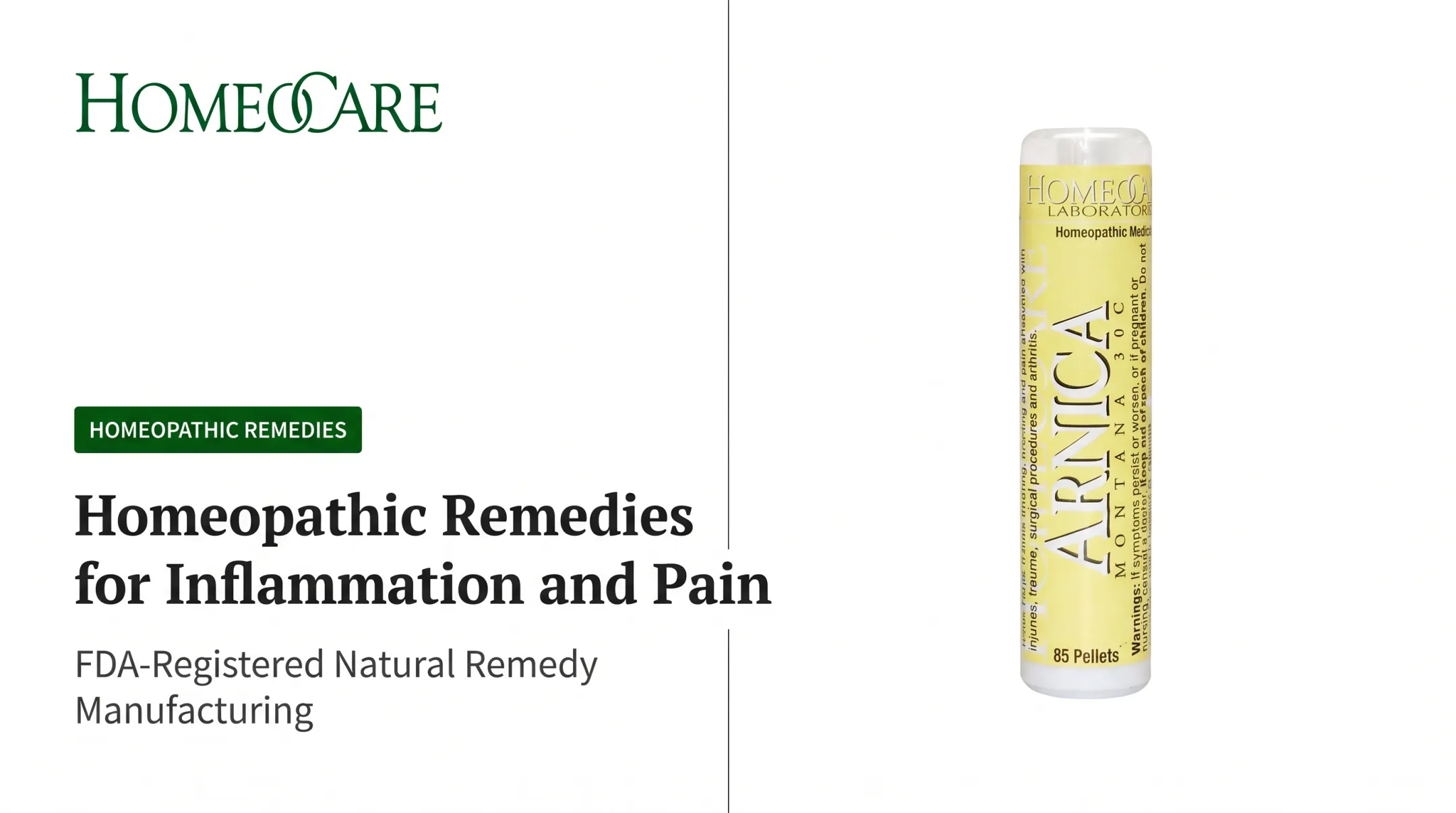
Arnica needs its own caveat. Homeocare sells Arnica Montana 30C, Arnica Relief Topical Cream, and Arnica Relief Tablets, each priced around $7.99 to $12.99. These are commonly used in homeopathic contexts for bruising and topical discomfort.
None should be presented as a proven way to clear acne. Topical arnica products generally aren't meant for broken or infected skin.
A Quick Checklist for Evaluating Remedy Claims
Before trusting any acne remedy claim, check for:
- The specific ingredient and dilution listed on the label
- The intended use as stated by the manufacturer
- Evidence cited, if any, and whether it's a real clinical trial
- Age restrictions and warnings
- Manufacturer information and contact details
- Whether the claim sounds medically unrealistic (permanent cure, works overnight, treats all acne types)
How to Use Homeopathic Acne Products More Safely
Understanding what a label and a registration mean protects you from misreading marketing as medical proof.
What FDA Registration Actually Means
FDA is explicit: no homeopathic product is FDA-approved, and these products haven't been reviewed for safety and effectiveness the way prescription drugs are. An establishment registration, drug listing, or National Drug Code (NDC) number doesn't mean FDA has approved the product or endorsed its marketing.
Homeocare is an FDA-registered homeopathic OTC drug establishment operating under cGMP (current good manufacturing practice) standards since 1995. That credential reflects manufacturing consistency. It does not establish that any specific product cures acne.

Reading the Label Correctly
Skip the dosing advice from blog posts and forums. Follow what's printed on the actual product. For example, Skin Klear Acne Relief's label recommends 3 to 5 pellets, three times daily, taken away from meals, with frequency reduced as symptoms improve.
When reviewing any homeopathic acne product, check:
- Active ingredients and their HPUS designation
- Inactive ingredients (for allergy concerns)
- Intended use statement
- Age guidance and pregnancy/nursing warnings
- Storage instructions
Who Needs Extra Caution
Certain groups should talk to a healthcare provider before starting any new product:
- Children and teenagers
- People who are pregnant or breastfeeding
- Anyone with known allergies or chronic health conditions
- Individuals currently taking prescription or OTC medications
Document your starting symptoms and any changes you notice. Stop self-treatment and seek medical advice if you notice irritation, swelling, spreading redness, severe pain, allergic symptoms, or lesions that worsen.
Acne Types, Causes, and Triggers to Consider
Acne vulgaris develops when hair follicles get clogged with sebum and dead skin cells. Bacteria that normally live on the skin can multiply inside the blocked follicle, driving inflammation.
Not all acne looks the same:
- Comedones — whiteheads (closed) and blackheads (open)
- Papules and pustules — smaller inflamed bumps, sometimes with visible pus
- Nodules and cysts — deep, painful lesions more likely to scar
What Contributes to Breakouts
Several factors can trigger or worsen acne:
- Hormonal fluctuations during puberty and rising androgen levels
- Family history of severe acne
- Stress (tends to worsen existing acne rather than cause it alone)
- Oily or occlusive skin and hair products
- Friction from helmets, masks, or tight clothing
- Certain medications
Dietary links remain debated. Small studies suggest a low-glycemic diet may help some people, while cow's milk has a weaker but noted association with breakouts in some research. Treat these as possibilities, not confirmed universal causes.

When Acne Might Signal Something Else
Certain patterns can point to an underlying hormonal issue:
- Acne along the jawline
- Recurring premenstrual breakouts
- Sudden adult-onset acne
- Breakouts with irregular periods or excess hair growth
These patterns deserve medical evaluation rather than reliance on a remedy alone.
Lifestyle and Skin-Care Support
A simple, consistent routine supports healthier skin regardless of what treatment you're using.
Basic habits worth keeping:
- Cleanse gently, without scrubbing — fingertips, not rough tools
- Choose non-comedogenic products labeled "won't clog pores"
- Avoid picking or squeezing lesions, which raises scarring risk
- Introduce new products gradually to watch for irritation
- Cleanse after sweating from exercise to limit pore congestion
Sleep, stress management, and regular movement support general skin health. Research linking them to acne severity is limited and mixed, so treat them as helpful habits rather than guaranteed fixes.
Diet deserves a cautious mention too. Before trying elimination diets or supplements, look for actual evidence rather than assuming a food group is the culprit.
These lifestyle steps support skin health; they are not a substitute for evidence-based acne treatment, especially when lesions are painful, persistent, or leaving marks.
When to Seek Professional Acne Care
Some signs mean it's time to stop experimenting and get a professional opinion.
See a dermatologist or primary care provider if you notice:
- Deep or painful nodules and cysts
- Scarring or dark marks that persist
- Rapidly worsening acne
- Extensive involvement on the chest or back
- Significant emotional distress related to breakouts
- No improvement after a reasonable, consistent routine
The American Academy of Dermatology notes that back acne treated appropriately should show some difference within 6 to 8 weeks. If it doesn't, reassess your approach.

Also watch for signs that something other than typical acne is going on:
- Sudden onset
- Severe inflammation
- Suspected medication-induced breakouts
- Symptoms that might actually be rosacea or folliculitis
Tell your clinician about every homeopathic, herbal, supplement, or prescription product you're using so your full care plan stays coordinated.
Frequently Asked Questions
How long does homeopathy take to cure acne?
Homeopathic acne treatment has no reliable universal timeline, and a cure isn't guaranteed. Response varies by acne type and individual. Persistent or worsening acne should be assessed by a healthcare professional.
What is the best homeopathic remedy for acne?
No single evidence-established "best" remedy works for everyone. Homeopathic selections are traditionally individualized based on your specific symptom pattern, so self-prescribing from an online list isn't recommended.
What is the fastest remedy for acne?
Be cautious of anything marketed as a fast fix. Real acne improvement generally requires a consistent routine and appropriate treatment over weeks, not days. Painful or severe lesions warrant professional advice promptly.
Does arnica get rid of acne?
Arnica isn't a proven acne cure. Different arnica preparations (topical vs. oral) have different uses and safety considerations, so follow the product label and check with a healthcare provider if unsure.
What are some homeopathic acne tablets available?
Rather than relying on an unsourced list, review current product labels for ingredients, directions, and warnings directly. A pharmacist or healthcare professional can help confirm whether a specific product is suitable for your situation.