That access comes with a catch: the "best" manufacturer isn't the biggest name or the one that ranks highest on a search results page. It's the one whose product category, regulatory status, formulation capability, minimum order quantity, packaging format, and quality systems actually match what you're trying to launch.
This guide ranks five verified US manufacturers for 2026. Homeocare appears first because it genuinely operates private-label, contract manufacturing, and contract packaging services for natural and homeopathic health products. The remaining entries span OTC, personal care, food and beverage, and supplements—each selected and fact-checked for its specific category strength, not general reputation.
Key Takeaways
- Private label lets you own the brand while a U.S. manufacturer handles formulation, production, and packaging.
- Category fit, regulatory readiness, and realistic MOQs matter more than company size.
- Our 2026 shortlist spans natural health, OTC self-care, personal care, food, and supplements.
- Always request written specs, samples, and credential verification before placing a production order.
- Homeocare fits supplement and natural health brands that need turnkey homeopathic, herbal, and private-label production.
Overview of American Private Label Manufacturers in the US Market
Private label manufacturing means a third-party facility produces a finished product to your specifications, then you sell it under your own brand. It's a distinct arrangement from a few related terms that often get used interchangeably:
| Sourcing Model | What It Actually Means |
|---|---|
| Private label | Manufacturer builds a product to your spec; formulation and packaging can be customized |
| White label | You brand an existing, manufacturer-developed formula with less customization |
| Contract manufacturing | A third party produces goods using its own facilities; supports private-label programs |
| Contract packaging | A third party fills, seals, and labels; some offer full turnkey service |
A solid US private-label partner typically covers the full path to shelf:
- Formulation or product selection
- Sampling and production
- Quality control
- Filling, labeling, and packaging
- Shipment prep
Work often stays under one roof or is coordinated across a few trusted vendors.
US store-brand sales hit $282.8 billion in 2025, growing 3.3% versus just 1.2% for national brands, according to PLMA's 2026 Private Label Report. That figure reflects broad consumer appetite for store brands. It doesn't guarantee the same margin or opportunity in every category, or with every manufacturer.

The manufacturers below cover different capability profiles: natural health and homeopathic products, regulated OTC self-care, high-volume personal care, large-scale food and beverage, and specialist supplement production. Match the profile to your product, not the other way around.
Top American Private Label Manufacturers 2026
This ranking weighs category relevance, verified US manufacturing presence, private-label capability, quality and regulatory systems, product-format breadth, and scalability. Unsupported revenue estimates or generic "top manufacturer" lists don't factor in. Only claims that hold up against current company and regulatory sources make the cut.
Homeocare
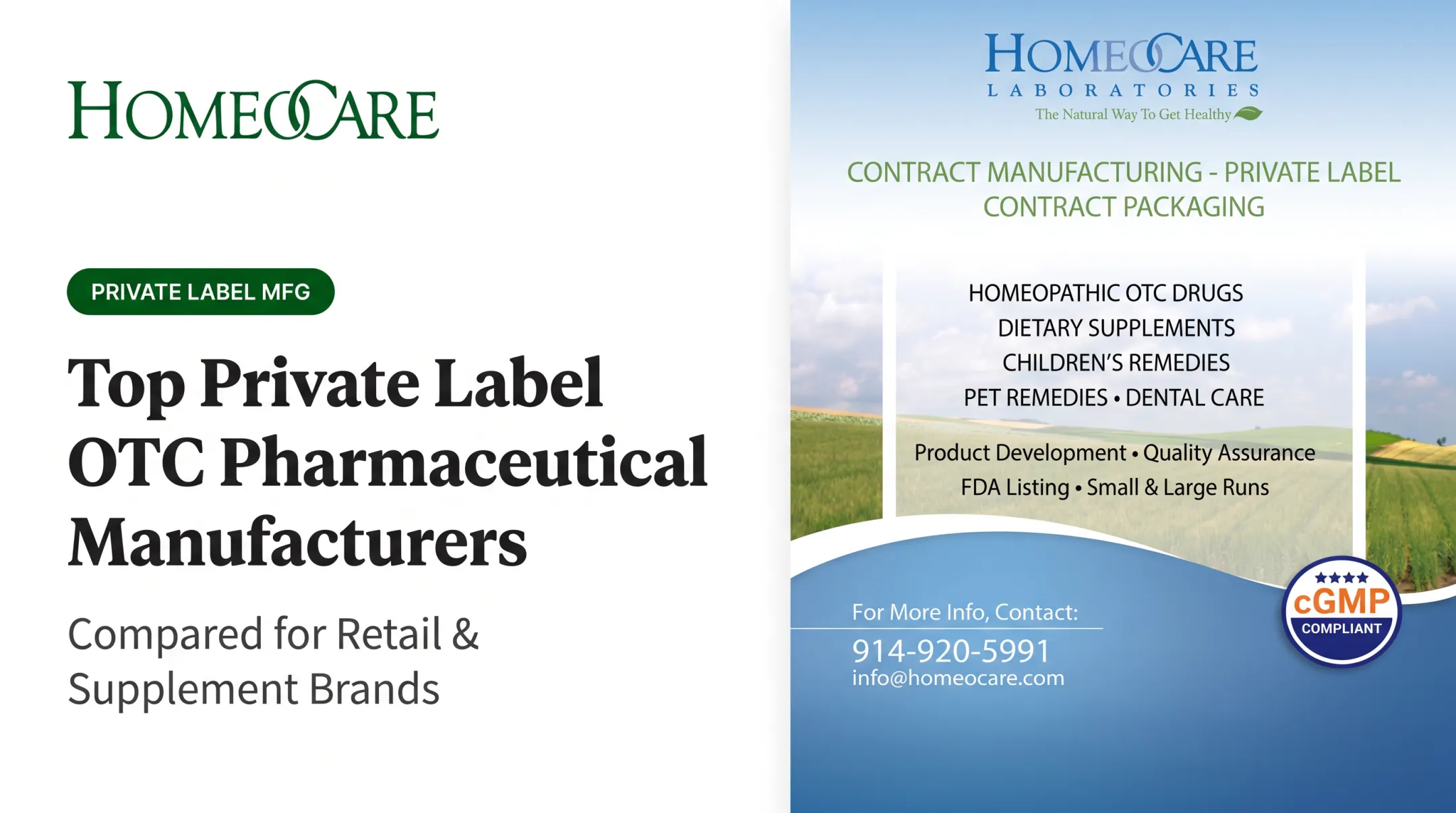
Homeocare Laboratories was created in 1995 and has spent three decades in the homeopathic remedies and natural health product sector. It serves consumers, supplement companies, and private-label brands that need turnkey production.
Key capabilities include:
- Private-label manufacturing, contract manufacturing, contract packaging, and wholesale fulfillment
- Formulations derived from European homeopathic masters
- Quality control throughout production, not only at final release
Homeocare Fact Panel
| Attribute | Detail |
|---|---|
| Regulatory status | FDA-registered homeopathic OTC drug establishment |
| Manufacturing standard | cGMP-compliant |
| Product formats | Tablets, pellets, capsules, creams, ointments, gels, liquids |
| Category scope | Herbal products, nutritional supplements, essential oils |
| Founded | 1995 |
Verify each current claim directly with Homeocare or applicable regulatory databases before contracting.
Homeocare fits brands building a natural health or homeopathic line that need multiple dosage or topical formats under one manufacturing relationship. It works well when you want a single turnkey partner instead of separate formulators, packagers, and labelers.
Before signing anything, confirm formulation ownership, testing protocols, claims support, MOQ, lead times, and the specific regulatory obligations tied to your product. No manufacturer profile substitutes for that homework.
Perrigo
Perrigo's 2025 annual report describes its Consumer Self-Care Americas segment as primarily supplying products sold under customers' own or exclusive store brands, serving major national and regional drug chains, supermarkets, mass merchandisers, e-commerce accounts, and wholesale businesses. That's a retailer-driven customer base, not an open small-brand program.
Its primary manufacturing operations sit in the US, anchored by a North American base in Grand Rapids, Michigan, while global headquarters remain in Dublin, Ireland. Separate 2026 operations postings show active sites in Allegan and Holland (Michigan), the Bronx (New York), Grand Rapids for oral care, and Covington (Ohio).
Perrigo Fact Panel
| Attribute | Detail |
|---|---|
| US operations | Grand Rapids, MI (North American base); additional sites in NY, OH |
| Category focus | OTC self-care, oral care (verified by site postings) |
| Customer type | Major retail chains and wholesale accounts |
| Regulatory note | FDA inspects facilities and reviews quality systems |
Perrigo suits established retailers or brands that already have regulated OTC products and need a partner capable of handling scale. Smaller or emerging brands should expect qualification requirements, larger minimum production runs, and less room for customization than a specialist supplement manufacturer might offer.
Vi-Jon
Vi-Jon's current product lineup, per its own site, centers on baby, foot, and body powders and scented or unscented Epsom salts in multiple pouch sizes. This is narrower than some older market summaries suggest.
A critical 2026 distinction matters here: Vi-Jon's parent, Emprise Group, announced in August 2026 that Vi-Jon, LLC began a voluntary Chapter 11 process tied to alleged legacy talc claims. Nice-Pak and Germ-X remain separate, unaffected operating businesses under Emprise. Don't attribute wipes or hand sanitizer manufacturing to Vi-Jon itself going forward.
Vi-Jon Fact Panel
| Attribute | Detail |
|---|---|
| Current categories | Epsom salts, body/foot/baby powders |
| US location | St. Louis, Missouri (company address) |
| Legal status (2026) | Chapter 11 process affecting Vi-Jon, LLC specifically |
| Not included | Wipes, Germ-X sanitizers (separate Emprise entities) |
Vi-Jon could work for private-brand dry bath product lines, but the Chapter 11 filing is a real operational risk factor. Ask directly about current production continuity, plant roster, and quality certifications before committing volume.
TreeHouse Foods
TreeHouse lists an extensive private-brand food and beverage catalog: crackers, pretzels, cookies, coffee, tea, powdered beverages, non-dairy creamer, broths, refrigerated dough, hot cereal, griddle products, pickles, and in-store bakery items, across shelf-stable, refrigerated, and frozen formats.
The company operates 25 production facilities across the US and Canada, not 25 US-only plants, with US locations including Cambridge (MD), Carrollton (TX), Cedar Rapids (IA), Faison (NC), Forest Park (GA), Lancaster (PA), Marietta (GA), and Moorestown (NJ). Its channels cover retail grocery, warehouse/club, e-commerce, foodservice, and co-pack arrangements.
TreeHouse Foods Fact Panel
| Attribute | Detail |
|---|---|
| Product range | Crackers, snacks, beverages, dough, condiments, more |
| Formats | Shelf-stable, refrigerated, frozen |
| Facilities | 25 across US and Canada combined |
| Ownership (2026) | Acquired by Investindustrial, completed February 11, 2026 |
A food manufacturer at this scale appeals to grocery retailers running multi-SKU programs who need category expertise, production continuity, and packaging flexibility. It's a poor fit for a start-up wanting low MOQs or small-batch runs—those buyers should look toward category-specific specialists instead.
PURE Private Label
PURE Private Label rounds out this list as a verified US supplement manufacturer with a genuinely different model: smaller-batch flexibility. The company lists US addresses in Statesville, North Carolina, and Alpharetta, Georgia, and specializes in capsules and powders across sports nutrition, general wellness, hair/skin/nails, and electrolyte/hydration products.
PURE Private Label Fact Panel
| Attribute | Detail |
|---|---|
| Product formats | Capsules, powders |
| Custom MOQ | Advertised starting at 144 units (confirm per formula) |
| Services | Stock and custom formulations, flavor development, sampling, label design |
| Compliance claim | Company states FDA registered, cGMP compliant (verify independently) |
Compared to Homeocare, PURE leans toward conventional supplement formats rather than homeopathic or multi-dosage natural remedies. Compared to Perrigo or TreeHouse, it's a far better match for start-ups and smaller brands needing lower minimums and faster onboarding. Confirm which specific address houses production before assuming both locations manufacture product.

How We Chose the Best Private Label Manufacturers
Choosing by search ranking, lowest quoted price, estimated revenue, or a broad product catalog alone is a common mistake. The right partner has to match your product, your compliance obligations, your volume, and your launch timeline: all four, not just one.
Regulatory and quality readiness:
- Verify FDA registration where applicable
- Confirm cGMP or category-specific certifications
- Ask about third-party audits, testing procedures, and batch records
- Understand allergen and contamination controls, plus claims-review processes
Dietary supplement manufacturers fall under 21 CFR Part 111. That rule requires ingredient-identity verification, master manufacturing records, documented batch production, and quality control sign-off before release, according to the FDA's current regulation. An OTC drug, a bath powder, and a food product don't share identical rules. Check the specific regime for your category.
Manufacturing fit:
- Stock formulations versus custom development rights
- Available product formats and packaging/labeling services
- Samples, MOQ by SKU, and realistic lead times
- Ingredient sourcing and capacity during seasonal demand spikes
Commercial and operational risk:
- Landed-cost transparency and payment terms
- Defect and recall procedures
- Intellectual property ownership and confidentiality provisions
- Shipping responsibilities and documented customer references
Practical shortlist process:
- Compare three to five manufacturers against your specific product requirements
- Request written specifications and physical samples
- Test samples against your agreed-upon requirements
- Review the manufacturing agreement line by line
- Validate every regulatory and marketing claim before placing a production order

Skipping any one of these steps is how brands end up locked into a supplier that can't actually deliver.
Conclusion
Choose an American private-label manufacturer that fits your category, compliance needs, product format, order volume, budget, and growth plan. Headcount and plant size are weak proxies for that fit.
Before you lock in a supplier, run this checklist:
- Compare verified credentials
- Request samples
- Confirm quality systems
- Check MOQs and lead times
- Review packaging options
- Calculate total landed cost
A lower unit price means little if the minimum order strains cash flow or compliance gaps create recall risk.
If you are a supplement company or private-label brand working in natural and homeopathic health products, Homeocare is a practical next call for private-label manufacturing, contract manufacturing, and contract packaging.
Reach the team at 914-920-5991 or info@homeocare.com to see whether the fit holds for your category and formats. No guarantees implied; treat it as one input in your own verification process.
Frequently Asked Questions
Who are the best American private label manufacturers?
It depends entirely on your category and scale. This shortlist includes Homeocare for natural and homeopathic health products, plus verified options in large-scale food, OTC self-care, and specialist supplement manufacturing.
Where can I buy private label products wholesale in the USA?
Buyers typically source through direct manufacturer relationships, wholesale programs, industry directories like Thomasnet, and trade shows such as PLMA's annual event. Always verify credentials, samples, MOQs, and fulfillment terms before ordering.
Who are the best private label supplement manufacturers in the USA?
Rank supplement partners on cGMP compliance, testing protocols, formulation ownership, dosage formats, labeling support, MOQ, and scalability. Homeocare supports natural, homeopathic, herbal, and nutritional formats specifically.
How do I start my own private label?
Validate your niche and map product plus regulatory requirements first. Then shortlist manufacturers, request samples, finalize branding and labels, complete a compliance review, run initial production, and set up sales channels.
Is private label still profitable?
Profitability depends on demand, landed cost, pricing strategy, MOQ, inventory risk, marketing spend, returns, and regulatory compliance. Market-wide growth statistics don't guarantee margin on any single SKU.
What are the most profitable private label products to sell?
Opportunity varies by demand, competition, repeat purchase rates, regulatory burden, production cost, and differentiation. Supplements, personal care, and food each have viable niches, but none carries a universal profit guarantee.