These remedies are not a replacement for diagnosis or medically recommended treatment. That's especially true when pain is severe, doesn't let up, or comes with symptoms that feel off. This article compares the traditional uses of arnica, Rhus tox, and bryonia, walks through what the evidence actually shows, flags safety considerations, and gives you a practical way to evaluate any product before you use it.
Key Takeaways
- Arnica, Rhus tox, and Bryonia match symptom patterns; tradition alone doesn't prove effectiveness.
- Clinical research for pain and inflammation is limited, mixed, or no better than placebo.
- Severe or worsening symptoms need a healthcare professional, not indefinite self-treatment.
- Always check labels for ingredients, dilution, warnings, and directions before use.
What Homeopathic Remedies Are and Why Evidence Matters
Homeopathy rests on two core ideas. "Like cures like" means a substance that causes symptoms in a healthy person is used, in diluted form, to treat similar symptoms in someone who's sick. The "minimum dose" principle holds that repeated dilution and succussion (vigorous shaking) increases a remedy's potency.
Some homeopathic dilutions are so extreme that no molecules of the original substance remain in the final product.
That mechanism differs from conventional anti-inflammatory medicines, which rely on measurable, dose-dependent chemical action.
Inflammation Isn't Always the Same Problem
Inflammation is the immune system's normal repair response, but it shows up in very different contexts:
- Short-term: a sprained ankle, a bee sting, muscle soreness after exercise
- Recurring or chronic: rheumatoid arthritis, osteoarthritis flares, autoimmune conditions
- Infection-related: a swollen, warm joint that may signal something more serious
Treating all of these the same way, with the same remedy, misses the point. The underlying cause needs to be identified before anyone self-treats, because masking symptoms can delay evaluation of a fracture, infection, nerve issue, or systemic illness.
What the Research Actually Shows
The National Center for Complementary and Integrative Health (NCCIH) states there is little evidence that homeopathy effectively treats any specific health condition. That assessment includes a 2015 Australian government review that found no reliable evidence of effectiveness across the conditions it examined.

Traditional use and personal anecdotes are not the same as clinical proof, and the two should be weighed separately.
Types of Homeopathic Remedies for Inflammation and Pain
Arnica, Rhus tox, and Bryonia are the three remedies most often discussed for pain and inflammation. In classical homeopathy, remedy selection is based on a person's full symptom picture, not simply a diagnosis like "arthritis" or "bruise." Here's what each one is traditionally used for, and what the research says.
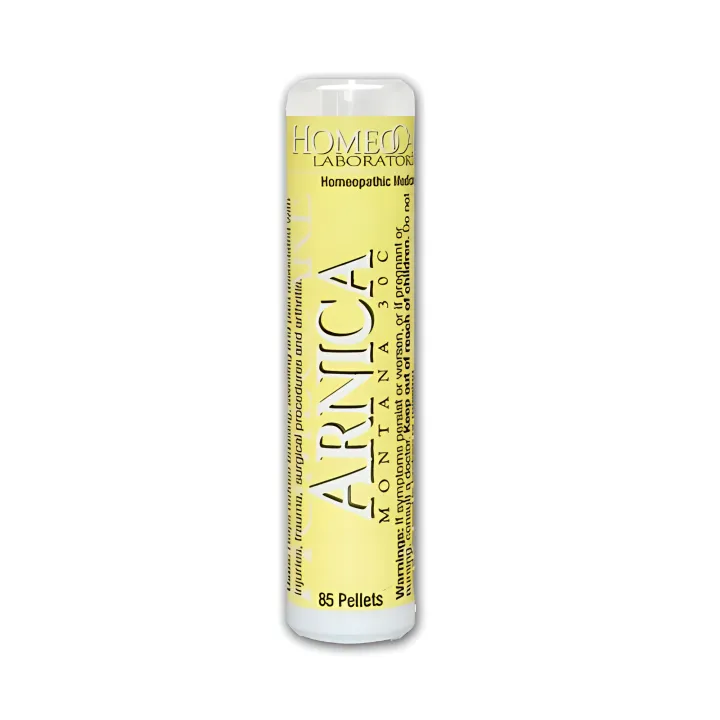
Arnica
Arnica is traditionally associated with soreness, a "bruised" feeling, and discomfort following minor knocks, falls, or physical exertion. These are traditional homeopathic claims, not established medical indications.
Clinical testing tells a mixed story:
- A 1998 systematic review of eight placebo-controlled trials found severe methodological flaws and concluded that rigorous studies did not support arnica's benefit beyond placebo.
- A 2003 randomized trial of 64 adults undergoing hand surgery found no meaningful difference between homeopathic arnica (6C or 30C) and placebo for pain, bruising, swelling, or pain-medicine use.
- A smaller 2006 facelift study found less photographed bruising in the arnica group on two of four measured days, but no difference on staff or patient assessments.
One important distinction: highly diluted homeopathic arnica products aren't interchangeable with concentrated herbal arnica gels or creams, which are tested and used differently. Follow the product label, avoid applying non-homeopathic arnica to broken skin unless directed, and seek care if swelling or pain suggests a more serious injury.
Rhus Tox
Rhus tox (Rhus toxicodendron) is traditionally linked to stiffness and aching that homeopathic theory describes as easing with continued movement. This pattern is a traditional framework, not a validated diagnostic tool.
Research findings include:
- A 1983 double-blind, placebo-controlled crossover trial tested Rhus tox 6X in patients with hip and knee osteoarthritis and found no significant difference from placebo.
- A later review of four trials and 406 patients noted inconsistent methods and study quality, and its authors said the evidence didn't support a firm conclusion either way.
Reliable evidence that Rhus tox reduces inflammation is lacking. Ongoing joint swelling, warmth, restricted movement, or recurring pain calls for a medical evaluation, not reliance on any single remedy.
Bryonia
Bryonia's traditional profile centers on pain described as worsening with movement and improving with rest. This description comes from homeopathic theory rather than clinical diagnostics.
The clinical picture is thinner than for arnica or Rhus tox. A 2010 trial of 92 patients undergoing aortic valve surgery tested a combination of Arnica montana and Bryonia alba against placebo, tracking bleeding, pain, and C-reactive protein (an inflammatory marker).
The result: no evidence the combination reduced bleeding, inflammation, or pain in that setting. Because bryonia wasn't tested alone, this study can't isolate its individual effect, so there's no reliable bryonia-only evidence for pain or inflammation.

Practical caution: check the exact product, dilution, and ingredient list before buying. Non-homeopathic botanical bryonia preparations carry different risk profiles than diluted homeopathic versions, and labels don't always make that distinction obvious.
How to Choose a Homeopathic Remedy Responsibly
Picking a remedy shouldn't come down to a condition's name or which product ranks highest in an online search. Start with the specifics of your situation.
Match the Pattern, Not Just the Label
| Remedy | Traditional Pattern | Typical Traditional Use |
|---|---|---|
| Arnica | Bruised, sore feeling | Recent minor injury, overexertion |
| Rhus tox | Stiffness that eases with motion | "Rusty gate" joint stiffness |
| Bryonia | Pain worse with movement, better at rest | Sharp pain aggravated by motion |
These patterns come from homeopathic tradition. They're a starting reference point, not a clinical assessment, and they shouldn't replace one.
Read the Label Before You Buy
Before using any product, check:
- Active ingredient and dilution notation (like 6C or 30C)
- Directions and dosing instructions
- Warnings, allergens, and inactive ingredients (sucrose or lactose bases are common)
- Intended route of administration (oral pellets versus topical cream, for example)
Know When to Loop In a Professional
Talk to a physician or pharmacist first if you are:
- Pregnant or breastfeeding
- Considering use for a child
- Managing a chronic illness
- Dealing with allergies
- Taking prescription medications
These situations carry higher stakes for interactions or delayed care.
A note on manufacturing: Homeocare has operated since 1995 and manufactures its homeopathic OTC products in an FDA-registered, cGMP-compliant establishment. That's worth knowing when evaluating manufacturing quality, but it's not proof of effectiveness.
The FDA is clear that no product labeled homeopathic has been FDA-approved. Establishment registration doesn't equal a review of whether a product treats inflammation or pain.
What to Check Before Using a Remedy
A homeopathic remedy should never be the reason you delay professional medical care. Seek immediate attention for:
- Severe or rapidly increasing swelling
- Fever, redness, or warmth around a joint
- Pus or an open wound that won't heal
- Chest pain, shortness of breath, or neurological symptoms
- Major injury or unexplained weight loss
If you're experiencing a medical emergency in the US, call 911 or go to the nearest emergency room.
Don't Assume "Natural" Means Risk-Free
"Natural" and "homeopathic" aren't synonyms for harmless. Some products labeled homeopathic have contained measurable active ingredients and caused real adverse events. The FDA has linked cases to contamination or incorrect dilution during manufacturing. Before using any remedy:
- Check with a pharmacist or clinician about interactions with medications or existing conditions.
- Keep a written record of every supplement and remedy you're using.
- Stop immediately if you notice an allergic reaction or new symptoms.
- Reassess rather than continue indefinitely. Persistent or recurring inflammation and pain need proper evaluation and evidence-based treatment—not months of unchanged self-treatment.
Conclusion
Arnica, Rhus tox, and Bryonia each carry their own traditional symptom profile, and each has been studied to some degree. None has clinical evidence strong enough to call it a proven treatment for inflammation or pain.
Responsible use means:
- Reading the label carefully
- Understanding what the evidence does and doesn't show
- Getting professional input for anything severe, persistent, or unclear
Homeocare has manufactured homeopathic products since 1995 in a cGMP-compliant facility with consistent quality control. That history reflects manufacturing experience, not a guarantee of effectiveness or FDA approval for any individual product.
Frequently Asked Questions
Is Arnica effective for reducing inflammation?
Evidence for homeopathic Arnica is limited and inconsistent, with controlled trials showing no clear advantage over placebo for pain or swelling. It's also distinct from concentrated herbal arnica preparations. See a doctor for significant swelling or injury.
Is Rhus tox effective for reducing inflammation?
Rhus tox is traditionally used for stiffness that eases with movement, but a placebo-controlled trial found no meaningful benefit for osteoarthritis. Reliable evidence that it reduces inflammation is lacking.
Is Bryonia effective for reducing inflammation?
Bryonia's traditional profile involves pain that worsens with movement, but clinical evidence is sparse. The one relevant trial tested it combined with Arnica, not alone, so it is not established as a proven anti-inflammatory on its own.
What are the common signs of inflammation?
The classic local signs are pain, swelling, redness, warmth, and reduced function in the affected area. Internal or chronic inflammation may not show these signs and often requires professional testing to identify.
Are homeopathic remedies safe to use for pain and inflammation?
Safety depends on the specific product, its ingredients, and your health situation. Review the label carefully and check with a pharmacist or clinician before use.
When should I see a doctor about inflammation and pain?
See a doctor promptly for severe, rapidly worsening, or recurring symptoms, or for swelling accompanied by fever, redness, or warmth. Chest pain, shortness of breath, or neurological symptoms are emergencies requiring immediate care.